We provide the information in the following structure:
eInvoice: Transitioning to a Modern and Efficient Electronic Invoicing System
 In cooperation with experts, software companies, accounting system providers and the business sector, the Financial Administration is launching the eInvoice project. The project's goal is to implement electronic invoicing, enabling automated processing and simplifying administrative procedures to increase efficiency. From the second quarter of 2026, companies and entrepreneurs will be able to voluntarily implement eInvoice. This approach is based on a successful European model that has already been adopted by more than twenty EU countries and other states, providing a stable, secure and efficient solution for hundreds of thousands of companies. The introduction of eInvoice in Slovakia is a significant step towards digitising and streamlining business processes. This transition to a modern invoicing method offers many advantages, including reduced administrative burdens, greater security, and increased transparency.
What is an electronic invoice?
 It is not just a regular PDF file or a digital photograph of a paper invoice. It is a structured XML file containing all the necessary information, such as the invoice number, issue date, item description, amount and recipient details. This format is designed to be machine-readable and processable, thereby eliminating errors caused by manual data entry. For companies and entrepreneurs, eInvoicing enables accurate and efficient communication with the authorities and business partners across the entire European market.
Benefits of eInvoice
Using eInvoice offers many advantages, including:
- Automated invoice processing: Elimination of manual data entry and transcription errors.
- Time savings and reduced errors: Automatic data processing reduces the risk of mistakes.
- Secure and efficient data transmission: Electronic invoices are securely transmitted through encrypted channels, ensuring their protection.
- Invoicing across the entire EU: eInvoice uses the Peppol system to enable seamless invoicing across EU member states.
- Compliance with Slovak and EU legislation: The system meets the legal requirements for electronic invoicing.
The European delivery standard that meets the requirements specified in Section 76a of Amendment No. 222/2004 Coll. [new window] to the Value Added Tax Act is the OpenPeppol AISBL
More info at The Future Is Open - OpenPeppol [new window].
Who is required to receive electronic invoices?
All legal entities and entrepreneurs who are taxable persons under Slovak law will be required to receive electronic invoices. This includes, for example:
- self-employed individuals; and
- those with a business licence.
- People practising liberal professions (e.g. lawyers, notaries, architects).
- Independently operating farmers
- Property owners renting out properties
In order to receive electronic invoices, it is necessary to contract a certified service provider, who will ensure that invoices are received correctly and in compliance with legal norms.
Electronic Invoicing via a Certified Service Provider
Electronic invoices will be sent and received via a certified service provider, which ensures the secure and efficient distribution of invoices between senders and recipients. You can use a certified service provider through an accounting programme, website or mobile application. This tool allows you to send and receive invoices, which is necessary to meet legal requirements. Entrepreneurs can choose from several certified service providers on the market that meet all technical and security requirements set by legislation.
What is Peppol?
 Peppol is a secure European network for the electronic exchange of business documents between companies. It operates like a digital mail system for invoices, orders and other documents.
The Peppol eDelivery Network
A secure and reliable network for the real-time delivery of electronic documents with guaranteed delivery.
Peppol BIS Format
A standardised invoice format based on the European standard EN 16931, ensuring compatibility across Europe.
European integration
Peppol enables connection with 21 countries across Europe, allowing seamless electronic invoicing across borders.
Important Dates
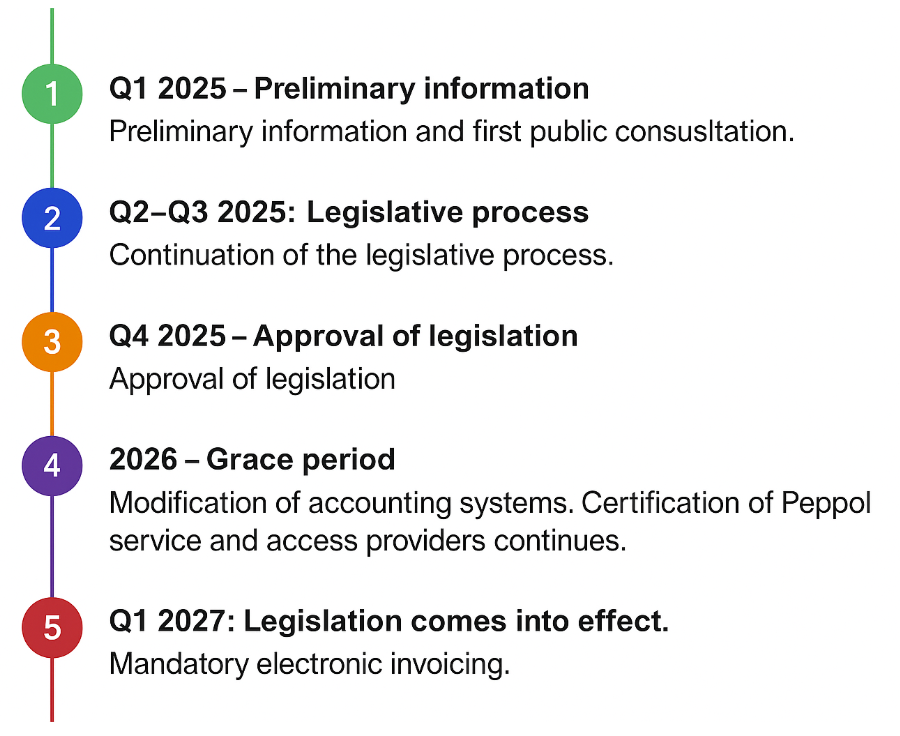
- January 1, 2026: The validity of the electronic invoicing legislation
- January 1, 2027: The effectiveness of the electronic invoicing legislation
Approved version of the law
222/2004 Z. z. [new window; slovak version] - Value Added Tax Act
Implementation Schedule
Information for certified service providers/intermediaries
Accreditation conditions
- OpenPeppol certification for einvoicing and e-reporting: a certified service provider must present a valid OpenPeppol certificate.
- Company headquarters in the EU: a certified service provider must prove that their headquarters or place of business is located in an EU member state.
- Integrity: the person and their statutory body or a member of the statutory body must be without a criminal record.
Start of accreditation for certified service providers
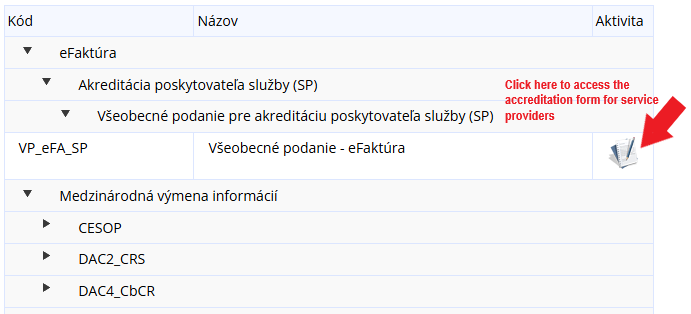
 A person can provide a delivery service in Slovakia as a certified service provider if they are registered in the registry. From 1 January 2026, the registry will be managed by the Financial Administration on its website.
Certified service providers can already apply to OpenPeppol for membership, certification of their software and issuance of the OpenPeppol certificate.
Further information can be found on the 'The Future Is Open' – OpenPeppol website [new window].
Readability of Invoices
In accordance with § 76a, paragraph 2c of the VAT Act, readability of invoices in XML BIS format must be ensured. This format is mandatory for all electronic invoices and must enable clear and comprehensible display of data.
Log security
Certified service providers must store logs of invoice delivery and receipt for at least six months. This step is necessary to ensure transparency and enable checks if needed.
Rights and obligations of certified service providers
Basic duties
Compliance with Peppol standards, providing user support and maintaining activity logs and incident reports.
Important:
The certified provider must obtain authorisation from the user via an application provided by the Financial Administration of the Slova
Sanctions
Failure to comply with the conditions will result in non-monetary sanctions, such as publication of status, suspension of access or withdrawal of authorisation.
Fees and costs
Each party bears their own costs. Certified service providers set their own prices for end users.
For intermediaries
Certified service providers can offer their services either directly or through intermediaries. Intermediaries use the services of certified service providers and sell them on their behalf.
Information for accounting software providers/portals
EN 16931: European standard for electronic invoices
This standardised format for electronic invoices in the EU defines the basic elements and structure of invoices to ensure interoperability between different systems.
Documents
- EN 16931 [.pdf; 11,9 MB; new window] - European standard for electronic invoices
Peppol BIS Format
A standardised format for electronic invoices based on UBL 2.1 that defines the structure, rules and limitations for electronic invoices on the Peppol network, in compliance with the European standard EN 16931.
Official Peppol BIS documentation
Implementation Guide
Comprehensive guide to implementing the Peppol BIS format, including the history of standards, an explanation of the structure of the documentation, how to read the specifications, how to validate documents, and practical steps for implementation.
Testing materials
Detailed manual and test cases for implementing Peppol BIS in Slovakia, created in cooperation with partners.
Test scenarios
Accreditation scheme in Slovakia
Application for Accreditation of a Service Provider
Elektronické form... - PFS
Sample Document „Letter of Authorization to deliver docum
Letter of Authorization to deliver documents [.docx; 19 kB; nové okno]
Slovakia – Peppol Authority Specific Requirements
Slovakia – Peppol Authority Specific Requirements [.pdf; 318 kB; nové okno]
Information for business owners:
How to get started:
- Contact the manufacturer of your accounting software. Check that they are ready to create and receive invoices in Peppol BIS format.
- Choose a certified service provider for the Peppol network (intermediary or a directly certified service provider).
- Testing and launch. Test sending and receiving invoices before the full launch.
List of certified delivery service providers
This list will be available after 1 January 2026.
Information for public administration:
How to get started:
- Contact the manufacturer of your financial software. Verify that you are ready to create and receive invoices in Peppol BIS format.
- Submit a public procurement request to a certified service provider for the Peppol network (intermediary or a directly certified service provider).
- Testing and launch. Test sending and receiving invoices before the full launch.
List of certified delivery service providers
This list will be available after 1 January 2026.
Frequently Asked Questions
Dokument
- 9/DPH/2025/IM [.pdf; 0,99 MB; new window; Slovak version]- Frequently Asked Questions
Webinar recordings and presentations